Jake Kennedy’s abduction and captivity
The Whisper ManJake Kennedy’s abduction and captivity is the decisive ordeal around which the novel’s personal and investigative narratives converge. It begins when Tom Kennedy discovers his father lying in a blood-soaked state and realizes that Jake has vanished from his room. The Packet of Special Things, left on the floor beside the bed, proves that Jake did not leave willingly. His disappearance places him in immediate danger, but it also forces Tom, Amanda Beck, and the police to confront the possibility that the same man who took Neil Spencer has taken Jake. The captivity therefore joins an earlier crime to a present emergency while testing whether the adults around Jake can distinguish apparent care from lethal control.
Discovery and Immediate Crisis
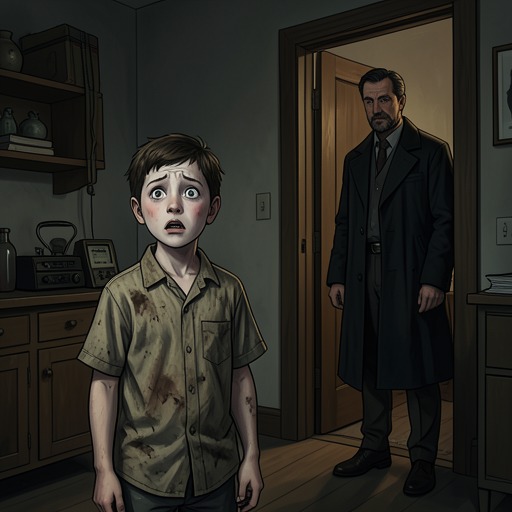
Tom Kennedy returns home expecting to find Jake with Rebecca. Instead, Jake is standing rigidly at the far end of the living room, shaking as he stares toward the floor, where Rebecca lies at the bottom of the stairs. Tom remembers moving his son away and calling an ambulance, but the intervening actions are obscured by shock. The scene establishes Jake as both a witness to catastrophic violence and a child whose response is largely silent; Tom’s worst fear is that Jake remembers everything but cannot or will not speak about it.
The later attack on Tom’s father makes the danger unmistakable. Tom sees his father lying beside the living-room window, surrounded by blood, and immediately thinks of Jake. Blood marks the upstairs landing, leading toward Jake’s room. The bed has been left with its sheet neatly folded back, but Jake is absent. Tom initially rejects the fact as impossible, because Jake cannot simply be gone. The Packet of Special Things supplies the concrete proof: Jake would not willingly have gone anywhere without it, and its presence means that the child has been taken. The discovery transforms Tom’s stunned paralysis into a desperate search.
The Search and the Stakes
Amanda Beck encounters Tom pacing through the spare room in an elaborate, repetitive path, moving like an animal confined in an enclosure. When he stops, his body begins to tremble. She understands that the motion is panic displaced into physical activity: unable to move toward Jake, Tom must move somewhere. Amanda tells him that she knows how terrifying the situation is and promises that they will find Jake. Her determination is not abstract reassurance. She intends to find the child and capture the man who took him, the same man connected to Neil Spencer’s disappearance and Pete Willis’s severe injuries.
Tom can imagine only the worst possibilities, especially because his son is alone with the captor. Amanda tries to preserve hope by recalling that, if this is the same man who took Neil Spencer, Neil was initially well cared for. Tom immediately supplies the terrible qualification: Neil was then murdered. Amanda has no answer that can neutralize that knowledge. Her thoughts turn to the apartment where Francis Carter recreated the decorations from his father’s extension, suggesting that the captor’s childhood horror has remained psychologically active. He may have looked after Neil for a time, but the earlier murder shows that apparent protection can become violence once the captor’s darker impulse breaks through.
The investigation also turns toward Jake’s school. When Amanda asks who drew a picture Jake had copied, she learns that it appeared recent, was made on the thick paper used at school, and had been brought home after Jake’s first day. That detail makes the school a possible source of information about the man or the house connected to Jake’s disappearance. The captivity is consequently not treated as an isolated family tragedy: its clues are distributed across domestic space, earlier cases, and the child’s ordinary school life.
Francis Carter’s Captive Logic
Francis Carter interprets the abduction through the distorted language of his own childhood. He remembers his father forcing him to watch the abuse and murder of boys, recognizing from his father’s expression that the hatred directed at those children could have been directed at Francis himself. The murdered boys functioned, in Francis’s understanding, as substitutes for the child he most despised: himself. He has carried forward the conviction that he was worthless and disgusting, while also believing that he can compensate for his inability to save the boys or comfort his younger self by rescuing children like him.
That logic produces a dangerous reversal. Francis imagines that he and Jake will be good for each other, turning a kidnapping into a supposed mutual rescue. The language of protection conceals the fact that Jake has no freedom and that Francis alone controls the conditions of safety. Francis has also changed his identity, acquiring a new one for less than a thousand pounds from a man sixty miles south, and has built a shell around himself as part of his transformation. Yet he still thinks of himself as Francis, the frightened and hateful boy formed by his father. His adult identity is therefore not an escape from the past but a structure built around it.
Francis’s conduct toward Jake reveals the instability of his benevolent self-image. Before going upstairs, he thinks that it is time to say good night to the boy and repeats to himself that there will be no more mistakes, even while remembering how killing Neil Spencer made him feel. The recollection places murder directly beside his domestic rituals of care. His preparations for Jake include clothes in the attic, a bed, and a chest of toys that he has kept for a long time. When he sees that Jake has dressed himself but has not touched the toys, Francis feels offended and expects gratitude. The objects intended as gifts become instruments of entitlement: because Francis has provided them, he believes Jake owes him appreciation.
Captivity as Coercive Care
Jake’s first morning in captivity shows how quickly ordinary language is commandeered. Francis greets him brightly and accepts that he has dressed himself, while Jake explains that he could not find his school clothes. Francis responds that Jake can have a day off. The exchange sounds domestic only because the surrounding coercion is temporarily hidden beneath routine. Jake is not choosing a holiday; he is being kept away from home, school, and his father.
The captor’s control becomes explicit when a woman warns Jake that the man is coming. Jake is ordered into bed, told to close his eyes, and instructed to pretend to be asleep as a key turns downstairs and the stairs begin to creak. He uses a practiced breathing pattern and loosens his eyes slightly because sleeping people do not squeeze them shut. This is not willing trust or emotional surrender. It is a precise survival strategy, learned through observation and adapted to an unfamiliar threat.
Francis nevertheless reads the child through the framework he is trying to impose. He senses Jake’s presence from below and feels that the house is fuller because there is a child upstairs. When he hears whispering, he becomes irritated by the possibility that Jake is keeping secrets. He does not understand secrecy as a response to fear; he treats it as a personal offense and a challenge to his authority. The captivity’s psychological mechanism is thus clear: Francis offers shelter while demanding access, obedience, gratitude, and emotional transparency.
The earlier experience with George Saunders provides Jake with a related pattern of false kindness turning into punishment. George examines Jake’s drawings and declares that they are not good enough. Jake knows the drawings are only an excuse, because George’s trembling hands reveal that he wants to become angry. When George says that Jake will have to be punished, the costume of goodness and kindness falls away in Jake’s perception, exposing the monster beneath. This memory gives the captivity a recognizable structure: the child learns that an adult’s apparently reasonable criticism can be the prelude to violence, and that safety depends on reading the adult’s changing mood before the punishment begins.
Parental Devotion and the Meaning of Rescue
Tom’s response to the abduction is shaped by helplessness, guilt, and a love he struggles to express directly. At dawn, while waiting in Karen Shaw’s house, he forms a message in his mind for Jake: he loves him and is going to find him. He experiences the ordinary continuation of the morning with astonishment, watching Karen prepare breakfast for Adam and hearing television from the living room while his own life has been torn open. The contrast makes the abduction more than a plot emergency. It isolates Tom inside a reality that the surrounding world cannot visibly acknowledge.
Tom’s resolve is also physical. After being attacked by Francis, he remembers only fragments of the morning: Jake shouting, the desperation to reach him, and the need to get to his son. The clearest surviving fact is that he had been ready to die for Jake. His body bears the cost in bandages, difficulty placing weight on one foot, and pain when Jake hugs him, but the injuries become evidence of a changed paternal commitment. Tom can no longer treat love as something that can remain implicit or postponed; the rescue has made it an action measured against death.
The story’s wider emotional pattern places Jake’s captivity beside the damaged relationships of earlier generations. Pete Willis’s past drinking is acknowledged as a consequence of many struggles, including his failure to be a good husband, while Francis’s violence emerges from a father’s abuse and hatred. Yet the image of a wounded man embracing Pete in sleep suggests a cycle reaching toward recognition and forgiveness. Against that inherited pattern, Tom’s determination to find Jake becomes an attempt to interrupt transmission rather than repeat it. The rescue cannot erase what Jake has witnessed, but it rejects Francis’s claim that captivity can become care merely because the captor names it protection.
Ending and Narrative Significance
Jake’s abduction and captivity concentrates the novel’s central opposition between genuine protection and possessive control. Francis believes that his history authorizes him to rescue children, but his method reproduces the essential structure of the violence he claims to oppose: a powerful adult isolates a child, controls his environment, demands compliance, and treats the child’s fear as something to be managed rather than respected. His conviction that he and Jake will help each other is therefore a tragic misreading of dependency. Jake’s apparent cooperation is better understood as alertness and survival.
For Tom, the crisis ends the distance that had defined his relationship with Jake. Before the abduction, Jake’s silence and withdrawal intensified Tom’s insecurity, and Tom often felt that his son would have responded more readily to Rebecca. Afterward, Tom watches Jake sleeping safely with the Packet of Special Things beside his bed. He has discovered the contents of the Packet and learned the truth about the little girl, but he does not yet have the words to tell Jake. The ending therefore refuses a simple restoration. Jake is home and safe, but the family still carries knowledge that cannot immediately be spoken.
The state remains significant precisely because rescue does not equal recovery. Jake has endured disappearance, confinement, threats, and the unstable performance of adult kindness, while Tom carries bodily injuries and the memory of being prepared to die for him. Their reunion offers safety without pretending that fear has vanished. The captivity’s deepest consequence is a newly explicit bond: Tom’s love becomes speakable, his commitment becomes demonstrable, and Jake’s return becomes not merely the end of a crime but the beginning of a difficult process of trust.